

About
I’m an AI engineer building agentic systems, multimodal AI, and bringing AI research into products.
My work mainly focuses on:
- LLMs with RAG pipelines and multi-agent architectures
- Multimodal AI for real-world problem solving
- Model serving and data pipelines for production ML systems
- Collaboration with domain experts to solve domain-specific problems using AI
Currently exploring AI agents and their practical applications.
Projects
AI Engineer, Naver – Agentic Search
— Multi-agent system for vertical-domain AI features.
AI Tab — Multi-Agent System for Vertical-Domain AI Features
NAVER Agentic Search
An agentic search system that routes user intent to specialized domain agents and delivers tool-grounded answers inside NAVER Search.
Objective- Help users complete search tasks with grounded, conversational answers
- Route complex search intents to specialized AI agents for vertical-domain tasks
- Build a next-generation Integrated Search powered by AI agents
Approaches- Designed a vertical-agent orchestrator for intent routing, context engineering, and coordination across domain agents
- Developed the search agent with query understanding, evidence grounding, and tool-augmented reasoning
Contributions- Developed core modeling and orchestration components for a multi-agent system, from system design through production deployment

- LLM-based agent orchestration, routing, context management, and tool usage
- Design of multi-agent systems for vertical domain applications
— RAG system for evidence-grounded generative briefings.
AI Briefing — RAG System for Evidence-Grounded Generative Briefings
NAVER Agentic Search
An AI-powered RAG system that finds relevant evidence, synthesizes briefings, and recommends follow-up content for search experiences.
Objective- Improve information access for complex natural-language queries by retrieving evidence and synthesizing briefings from large-scale content sources
- Support domain-specific briefing use cases, including finance and sports
Approaches- Designed retrieval-augmented pipelines for evidence retrieval, summarization, and recommendation
- Optimized LLM behavior with supervised fine-tuning and preference optimization
- Adapted the retrieval framework to domain-specific briefing scenarios such as finance and sports
Contributions- Developed core evidence retrieval, RAG, and LLM optimization components for production briefing features
- RAG and generative AI pipelines for evidence-grounded briefings
- Domain-knowledge adaptation for specialized verticals, including finance and sports
AI Engineer, Naver – Multimodal AI · Technical Research Personnel (military service fulfilled)
— Product segment identification for live-commerce replay sessions.
Lens X Shopping — Product Segment Identification in Live-Commerce ReplaysNAVER Smart Lens
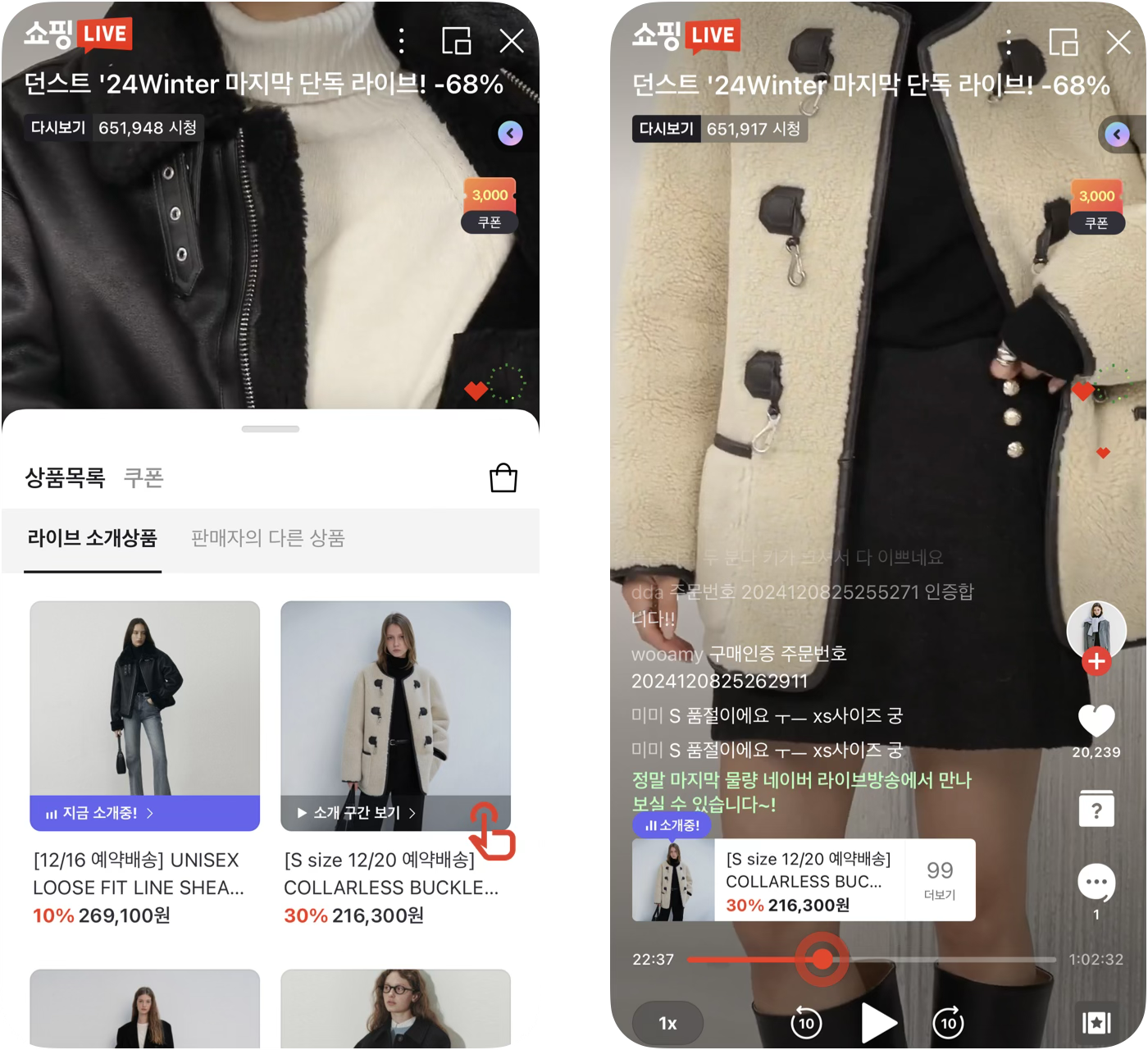
An AI-powered service that identifies product-focused moments in live-commerce replays and links them to purchasable product cards.
Objective- Improve product discovery in live-commerce replays by linking product-focused segments to purchasable products
Approaches- Identify product segments in live-commerce replays using multimodal AI
- Implemented production model serving with gRPC and TensorRT
- Designed the V1 system with FastAPI and nginx on Docker Swarm
- Designed the V2 system with Spark Streaming, Kafka, and HBase
Contributions- Led the project end to end, from model development and serving system design to production rollout and operation
- Contributed to significant GMV growth in AI-powered categories
- Product segment identification using multimodal AI
- Data streaming pipeline design and operation using Spark and Kafka
— Relevance matching between queries and landing pages for Powerlink ad search.
Lens X Ads — Relevance Matching Between Queries and Landing Pages for Powerlink
NAVER Smart Lens
ADVoost, a Powerlink ad search service, analyzes advertiser landing pages to match relevant ads with user queries.
Objective- Expand Powerlink ad exposure to search queries highly relevant to advertiser landing pages
- Prevent keyword abuse by grounding ad exposure in query–landing page relevance
Approaches- Modeled similarity between search queries and landing page content using generative AI
- Built batch scoring pipelines for large-scale ad search matching
Contributions- Developed query–landing page relevance modeling and production batch pipelines for Powerlink ad search
- Contributed to revenue growth through improved CTR, query coverage, and CPC efficiency
- Query–landing page relevance modeling using generative AI
- Batch pipeline design and operation for a large-scale ad matching service
— Key-moment extraction for easy navigation in long-form videos.
Lens X TV — Key Moments for Long-Video Search NavigationNAVER Smart Lens

An AI-powered service that identifies important segments in long-form videos and surfaces them beside video previews, helping viewers jump directly to desired sections.
Objective- Improve long-form video navigation by highlighting key moments
- Reduce unnecessary scrubbing and help viewers reach desired sections faster
Approaches- Identify and highlight key video segments using multimodal AI
- Designed a periodic batch-processing system with Airflow
Contributions- Developed the AI Key Moments extraction system from research PoC to production rollout
- Increased CTR from near zero to 15% among same-topic videos with comparable rankings
- Key-moment extraction for long-video navigation using multimodal AI
- Batch processing pipeline design and operation with Airflow, Spark, and HBase

Research Engineer, Golfzon – AI Golf Lesson
— AI golf swing analysis and coaching system.
AI-powered Golf Swing Analysis and CoachingGolfzon AI Lab

An AI-powered golf coaching service that identifies swing-error patterns from swing motion captured during screen golf gameplay.
Objective- Analyze golf swing motion from video for personalized lesson feedback
- Identify swing phases and posture patterns that affect shot consistency
Approaches- Estimated human pose and tracked body-joint trajectories across swing sequences
- Applied action recognition and localization to classify swing phases and motion characteristics
- Collaborated with professional golfers to translate domain expertise into AI-driven coaching logic
Contributions- Built core AI models from scratch for AI Golf Lesson Pro, leading model design and research through production-ready delivery
- Contributed to 80% YoY MAU growth and KRW 4B in annual revenue through model improvements

- Human pose estimation and action recognition for swing-motion analysis

Research Assistant, Severance Hospital – Clinical AI
— Brain disease progression analysis on medical imaging.
AI-assisted Analysis of AD Progression Patterns in Brain PETYonsei University, College of Medicine
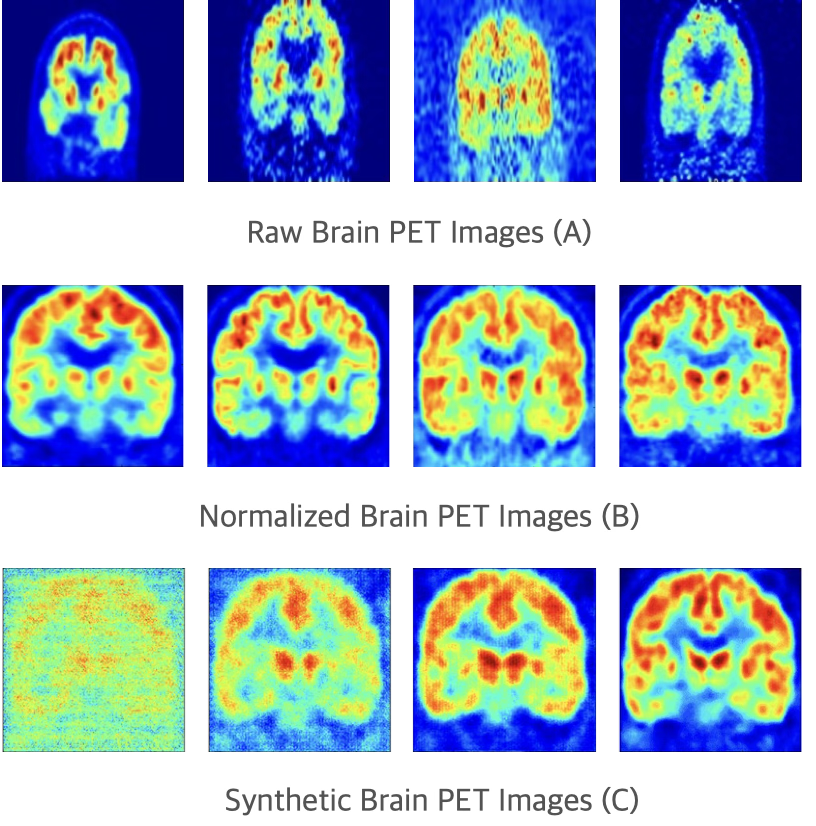
Investigated clinically meaningful progression patterns for early diagnosis of brain disease using generative AI, validated through statistically significant clinical findings.
Objective- Develop an ML model robust across PET imaging environments
- Discover clinically meaningful progression patterns using generative AI
Methods- Standardized PET images across patient motion, intensity, and anatomical variation
- Applied slice-selective learning and generative AI to improve robustness and interpretability
Contributions- Proposed a PET image normalization strategy for robust ML model across heterogeneous imaging environments
- Demonstrated the clinical value of generative AI for early diagnosis and progression-pattern analysis

- Volumetric medical image processing for brain disease analysis
- Generative adversarial network modeling for medical image-based clinical analysis
Publications
Slice-selective learning for Alzheimer’s disease classification using a generative adversarial network
HanWoong Kim, HaEun Lee, Sangwon Lee, KyeongTaek Oh, Mijin Yun & Sun K. Yoo
EJNMMI, 2020Multi-slice Representational Learning of CNN for AD Classification using Positron Emission Tomography
HanWoong Kim, HaEun Lee, KyeongTaek Oh, Sangwon Lee, Mijin Yun & Sun K. Yoo
BioMed Eng OnL, 2020